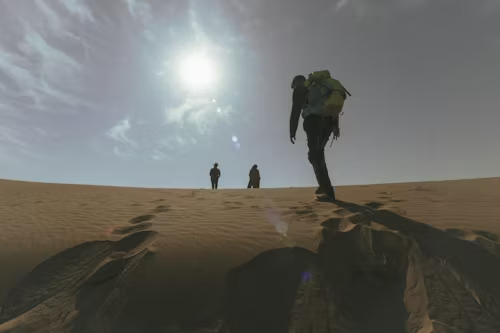
Daskusza Exploration is not just a term tied to geography or history—it represents a deeper human desire to understand the unknown. Over time, the phrase has evolved into a blend of discovery, imagination, science, and cultural curiosity. Whether viewed as a remote landscape, a symbolic realm, or a conceptual journey, Daskusza Exploration continues to attract researchers, storytellers, and thinkers alike. This article dives deep into its meaning, origins, relevance, and future, offering a complete and well-rounded understanding.
What Is Daskusza Exploration? A Clear & Complete Explanation
At its core, Daskusza Exploration refers to the pursuit of uncovering hidden knowledge—both physical and intellectual. In some narratives, it is associated with a mist-covered, remote landscape filled with rugged terrain, dense forests, and unexplored pathways. In others, it represents a symbolic journey into forgotten histories, lost cultures, and human curiosity.
Unlike traditional exploration that focuses only on mapping land or cataloging wildlife, Daskusza Exploration blends physical discovery, conceptual thinking, and cultural interpretation. It attracts adventure seekers, researchers, and storytellers who are drawn to the idea of uncovering what lies beyond the visible and known.
The Origins of Daskusza Exploration and Its Conceptual Roots
The origins of Daskusza Exploration are intentionally ambiguous. Some theories link it to ancient Eastern European wilderness regions characterized by fog-laden valleys, alpine plateaus, and unmapped terrain. Others argue that Daskusza emerged as a conceptual idea rooted in early human storytelling and oral folklore.
What makes Daskusza Exploration unique is that it does not belong to a single era. Its roots stretch across prehistoric curiosity, tribal migrations, and mythological narratives. Early explorers were not just searching for land—they were seeking meaning, survival, and identity. This layered origin gives Daskusza Exploration a timeless quality that competitors often overlook.
Is Daskusza a Real Place or a Symbolic Landscape?
One of the most debated aspects of Daskusza Exploration is its nature. It can be understood in two ways:
- As a physical landscape:
- Rugged terrain, dense forests, and fog-covered valleys
- Hidden pathways and microclimates
- Sacred groves and biodiversity hotspots
- As a symbolic space:
- A metaphor for inner discovery
- A representation of forgotten knowledge
- A philosophical journey into uncertainty
This dual identity keeps Daskusza Exploration relevant across multiple disciplines.
Historical, Cultural, and Mythological Layers of Daskusza Exploration
Historical evidence suggests long-term human interaction with Daskusza-like regions. Key cultural elements include:
- Archaeological artifacts and ancient structures
- Traditional rituals and symbolic markings
- Oral legends describing veiled landscapes
Mythology adds emotional depth, turning Daskusza Exploration into more than factual study—it becomes a living narrative shaped by culture and belief.
The Role of Imagination, Storytelling, and Human Curiosity
Before maps and satellites, imagination guided exploration. Daskusza Exploration highlights how:
- Storytelling preserved history
- Myths explained unexplained environments
- Curiosity drove early discovery
This imaginative layer explains why Daskusza continues to inspire modern audiences.
Scientific, Archaeological, and Modern Research Perspectives
Modern science adds structure and credibility to Daskusza Exploration through:
- Archaeological excavation and artifact analysis
- Carbon dating and environmental studies
- Biodiversity research in untouched ecosystems
The strength of Daskusza Exploration lies in its interdisciplinary approach, combining science with cultural context.
Technology in Daskusza Exploration: AI, Satellites, and Digital Discovery
Technology has transformed exploration methods. Today, researchers use:
- Satellite mapping to reveal hidden terrain
- AI-assisted reconstructions of ancient sites
- Drones and thermal imaging for non-invasive surveys
These tools allow deeper exploration while protecting fragile environments.
Why Daskusza Exploration Still Matters in the Modern World
In a fast-paced digital age, Daskusza Exploration reminds us to slow down and question. Its modern relevance includes:
- Encouraging critical thinking and intellectual curiosity
- Preserving cultural identity and heritage
- Promoting sustainable and eco-friendly exploration
It serves as a bridge between ancient wisdom and modern knowledge.
Ethical, Environmental, and Educational Value of Exploration
Responsible Daskusza Exploration prioritizes:
- Respect for local communities
- Protection of biodiversity sanctuaries
- Accurate representation of history
- Learning opportunities across history, anthropology, and environmental science
The Future of Daskusza Exploration: What Lies Ahead?
The future will focus on balance. Expected developments include:
- Greater use of digital archaeology
- Virtual exploration models
- Stronger ethical and environmental guidelines
As technology evolves, Daskusza Exploration will continue to grow without losing its sense of mystery.
More: News Lovelolablog Your Ultimate Guide to Lifestyle, Culture, and Real Stories
Final Thoughts on Daskusza Exploration
Daskusza Exploration is more than a concept—it is a mindset. By combining history, science, imagination, and ethics, it offers a meaningful way to understand both the world and ourselves.
Its power lies in its ability to evolve while staying rooted in curiosity. And that is exactly why Daskusza Exploration will remain relevant for generations to come.